
Climate change getting increasingly real: New Orleans, Corpus Christi, and El Niño
Three important climate stories

Welcome, new subscribers! I’m thrilled to have you, please grab a drink and make yourselves at home. :)
My apologies for the radio silence lately, it’s been a busy stretch over here at Climate Resilient Homes. When you’re a climate-focused real estate agent in the midst of a climate crisis, there’s a lot to do. I’ve been updating my website and co-creating a new logo, both with the great Elise Grinstead. I’ve also been working with clients looking for, well, climate resilient homes!
Based on what I’ve being hearing and seeing, I’m leaning into interest in climate relocation. There are infinite versions of this - all the way from cross-country to within the neighborhood - because people’s circumstances and priorities vary, but it’s clearly an under-served need. Among other things, I’m working on a guide to help people just beginning to wonder about relocation think rigorously about the decision. More to come on this soon!
Climate Change is Getting Increasingly Real
There are always more climate stories playing out around the world than one can possibly stay on top of. These are three I’m following closely:
The recent research paper on New Orleans’ dire climate future.
The approaching 2026-27 “Super El Niño.”
The worsening water shortages in and around Corpus Christi, Texas.
New Orleans
In a new paper published this week in the Nature Sustainability journal, climate researchers at Tulane University projected that sea level rise will inevitably swallow New Orleans, and it may happen in this century. As co-author Jesse Keenan put it,
“How long is not certain but it’s most likely decades rather than centuries. Even if you stopped climate change today, New Orleans’s days are still numbered. It will be surrounded by open water, and you can’t keep an island situated below sea level afloat. There’s no amount of money that can do that.”
While the timeline is jarring, news of New Orleans’ inevitable inundation by the sea isn’t surprising. Most of the city’s footprint sits below sea level, after all. From local Fox affiliate WVUE:
“Ultimately, the main message of the study is New Orleans is not forever and we have to plan for our future and we have to start planning now,” said Dr. Torbjörn Törnqvist, a geology professor at Tulane University and lead author of the study.
…One of the study’s key findings goes back about 125,000 years, when researchers say the Gulf reached an ancient shoreline north of Lake Pontchartrain, roughly 30 miles north of New Orleans. …[J]ust north of that shoreline could become the new coastal real estate, if you will,” Törnqvist said. “They are sitting right on the future shoreline. Everything south of it is going to be ocean.”
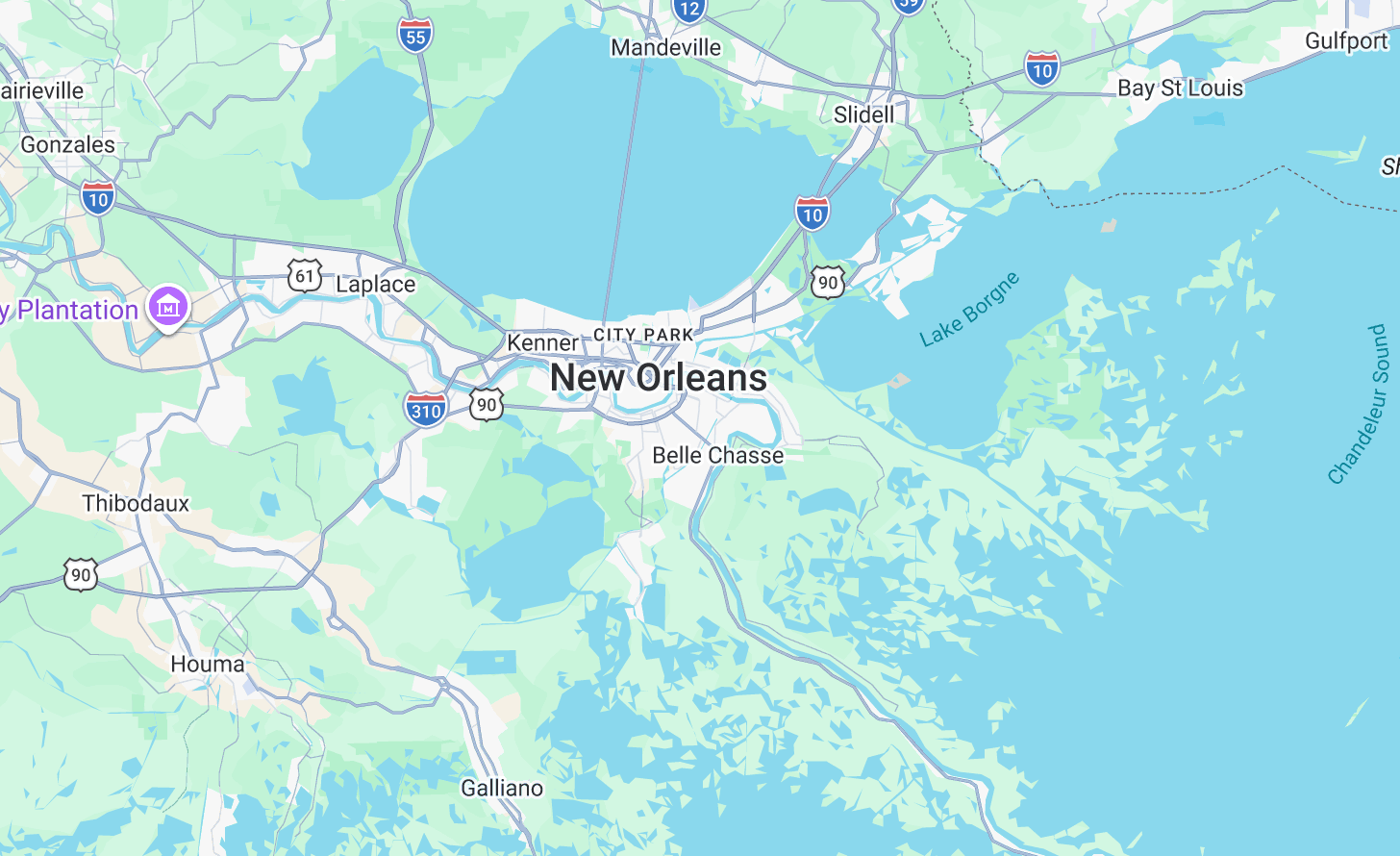
To put those words into geographical context, here’s where New Orleans sits in relation to Lake Pontchartrain.
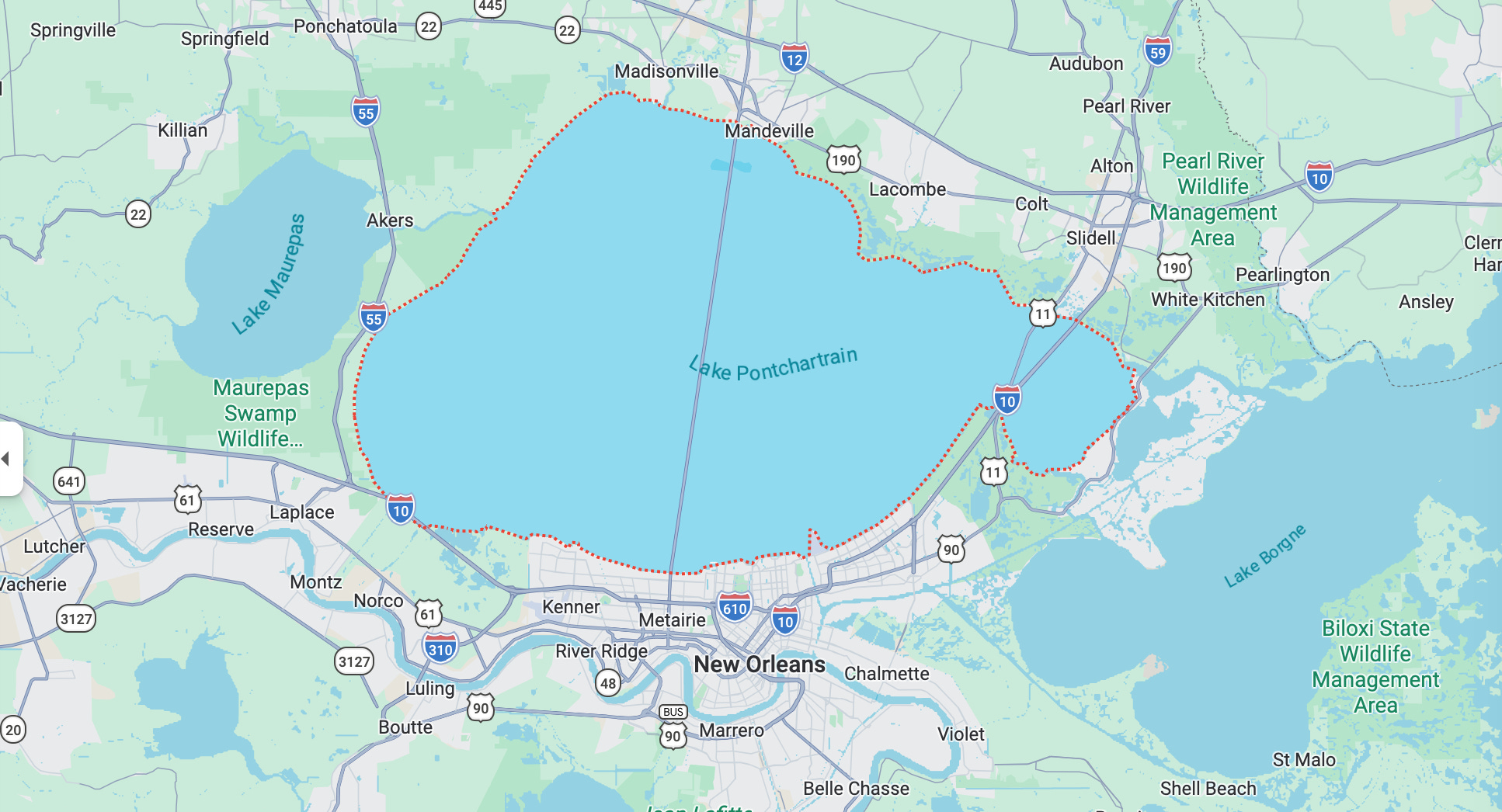
If you zoom out, you can see how close the Gulf waters already are to the city. As you probably intuit from the map, Pontchartrain is not a freshwater lake, it’s a brackish estuary where freshwater from rivers mixes with saltwater from the Gulf of Mexico. The encirclement of New Orleans by the sea is already quite far along.
Southern Louisiana has been losing roughly 30 square miles of land annually to sea level rise for years, with the rate accelerated by regional subsidence (sinking land). This NOAA visual shows the land mass on one part of the coast in 1932 and then in 2011. The disappearing land is being submerged under the rising sea.

All climate losses are tragic,1 but some will hit us harder than others. This one hits me awfully hard. New Orleans is one of my very favorite places in the world. Sure, I enjoyed my share of debaucherous nights there when I was young, but that’s true of a number of other places. New Orleans is unique, there’s no place remotely like it, but that’s not what keeps it in my heart. My wife and I even had our first kiss there, which adds to its romance, but that’s not the core of it, either.
I just always found New Orleans profoundly calming. Was it a vacation effect? Partly, I suppose, but not entirely. Whenever I arrived there I would immediately feel more at ease - even in the airport! Everything about the place seems to say, “Relax, my friend, you’re here now.” The quality I’m describing isn’t quite welcoming, though the city is that. It’s more like a sense that the city is comfortable in its own skin and there’s plenty of its wonderfulness to go around, to share with whoever shows up.
We now know that not only is New Orleans’ time limited, but the end is not all that far off. The drowning of New Orleans is uncomplicated in some ways, even as it’s utterly heartbreaking. But even though the physical process is straightforward, I find I can’t quite wrap my mind around it.
I’ll be eager to read the first think piece about whether you can relocate an entire city to a nearby suburb. While I’d love to be wrong, my money is on “Lol, no.” Maybe some cities, but not New Orleans.
The tragedy is sharpest for the people of New Orleans, of course, and I can’t fathom their loss. Maybe they can’t, either. Or maybe they’ll put off the fathoming as long as they can. I don’t know. I do know I want to take our kids to New Orleans soon, while it’s still right there. I want them to experience what it’s like to sink into the sweet, humid air and easy charisma of one of the most special and truly great cities in all of human history. I don’t think that’s remotely an exaggeration, and I hope they agree.
Super El Niño
Scientists aren’t certain yet, but evidence is stacking up that the El Niño arriving this year will be a powerful one.2 Here’s how David Wallace-Wells described the phenomenon generally and the emerging forecast for this one:
A marine heat-wave in the Pacific Ocean scrambles global weather and produces in some places more intense droughts and in others more intense rainfall and flooding; disruptions to hurricane patterns and monsoon seasons, which can cause widespread crop failures; and much more punishing heat.
The El Niño building right now, and expected to crest around the end of next year, arrives on top of all our global warming. And it appears stupendously intense — almost certainly stronger than the “Super” El Niño of 2015-16, and perhaps the most intense since the epochal El Niño of 1877.
Some climate folks are quietly hoping a year of dramatic El Niño weather will wake people up and shift the political dynamics around climate action. It’s a worthwhile hope but, for two reasons, we should temper our expectations.
First, climate-fueled weather disasters, from hurricanes to wildfires to severe drought, generally haven’t had this effect. The reality that such disasters aren’t new has tended to outweigh in people’s minds the more significant fact that climate change is generating meaningfully more big ticket disasters than we had even quite recently.

Second, Americans may not even perceive the next 12-18 months as a period of notably extreme weather. Not just because of information bubbles and Big Oil-funded disinformation smoke screens, but also because the most destructive weather events in the U.S. tend to be hurricanes, and El Niño is correlated with less active hurricane seasons.
All that said, we should expect the coming year-plus to feature particularly severe weather extremes globally. Unlike 1877, this El Niño will be happening in the context of about 1.4 degrees Celsius of global heating above the pre-Industrial baseline. Stay tuned, things could get dicey.
Texas Water Crises
Another situation I’m tracking, which could be affected by El Niño, are the water shortages in the Coastal Bend region of Texas. Several municipalities in the area, most notably the largest, Corpus Christi, are on the verge of serious water supply crises due to a sustained lack of rain. From an April 28th report in the Texas Tribune:
The region has been gripped by an unforgiving drought, pushing the city’s main reservoirs to historic lows. More than 95% of the city’s water supply comes from surface water and its two main reservoirs, Lake Corpus Christi and Choke Canyon Reservoir, have dropped to just 8% of capacity,3 prompting city leaders to scale up drought contingency plans.
The article is about how the city council delayed a vote on whether to impose a water use restriction regime that would limit monthly household water use to 5,250 gallons.
Susan Gonzalez said it would be difficult for her household of four to stay under the 5,250-gallon limit. Her most recent water bill charged her for around 10,000 gallons, and that’s after taking steps to reduce use by complying with outdoor watering restrictions and, “much to my heartbreak,” letting her 85-year-old magnolia tree die, she said.
In recent years, a number of water supply crises in major cities like Sao Paulo, Cape Town, and Chennai have been averted when rains arrived just in time. There’s a fair chance that will happen in Corpus Christi, though it may not.
An interesting dynamic to watch is that the biggest water users in the area are petrochemical companies, not households.
The largest proposed restrictions would be felt along the petrochemical corridor on Corpus Christi Bay. The city’s biggest water customers are roughly 20 large refineries and other industrial companies that collectively consume up to 60% of the city’s water supply, according to local officials.
Industry, which the curtailment plan classifies as large-volume customers, would have baselines calculated according to average water use each season. If the emergency is triggered in September, refineries would have to reduce water use by 25% based on the average amount used in October and November.
Winkelmann on Tuesday said large-volume customers use a combined average of 30 to 35 million gallons a day. Meanwhile, residents use about 14 million gallons daily.
What the article doesn’t mention, but is undoubtedly a big political variable in determining whose use to restrict use and by how much, is these companies employ thousands of local residents. Nobody relishes cutting back significantly on water use at home, but nobody wants to lose their job because their company can’t operate at full capacity, either.
These hard choices of the climate change era. Get used to them, more are coming.
There are interesting questions in here about when exactly a loss occurs. If New Orleans will be under water 60 years from now, meaning a child today can’t plan to build their life there (at least not all of it), has the loss already occurred? How much of it? Can losses be divided up and spread over time like that? These are academic questions, perhaps, but they feel emotionally relevant.
El Niño is notable for being the topic regularly in the news that’s hardest to get a solid conceptual handle on. No two explanations of it are ever quite the same.
Eight percent! That’s as full (empty) as an egg carton containing a single egg.